Nearly a week after 37-year-old Renee Nicole Good was fatally shot by an ICE agent in Minneapolis, new details about her final morning are emerging, adding another layer of heartbreak to a case that has already shaken the city and sparked nationwide outrage.
On a snowy Wednesday morning, Good was doing something entirely ordinary. She had just dropped her six-year-old son off at school and was driving back home through her neighborhood. Riding with her was her current partner, and in the back seat of the vehicle was their dog. It should have been an uneventful drive — the kind of routine moment most families never give a second thought.
Just a few blocks from home, that routine ended abruptly when they encountered a group of Immigration and Customs Enforcement agents conducting an operation in the area. What happened in the moments that followed has become the focus of intense public scrutiny after new cellphone video surfaced.
The footage, released days later, appears to have been recorded by the ICE agent who ultimately fired the fatal shots. In it, Renee sits in the driver’s seat of her maroon SUV as sirens blare and an officer approaches. Her voice is calm, almost reassuring.
“That’s fine, dude,” she says through the open window. “I’m not mad at you.”
At the same time, her partner can be heard and partially seen confronting the agents, demanding that they show their faces while holding up her own phone to record the interaction. She asserts that they are not hiding anything and states that their license plates are not changed. The exchange is tense, but at that moment, it still resembles a heated confrontation rather than a fatal one.
As the situation escalates, another officer moves toward the driver’s side, shouting forcefully for Renee to get out of the car. Her partner shifts position inside the vehicle. The SUV briefly backs up, then moves forward while turning to the right. In the video, the agent recording suddenly shouts in alarm, and the camera jolts upward.
Gunshots ring out.
The vehicle speeds forward for a short distance before a crash is heard. In the chaos that follows, a voice is captured shouting a slur, while Renee’s partner is heard screaming in anguish moments later. She is reportedly covered in blood, crying out that her wife has been shot in the head and repeatedly blaming herself, saying she made Renee come down there and that their six-year-old child is still at school.
The presence of the dog in the back seat — visible in the footage and reportedly unharmed — has struck many viewers as an especially haunting detail, underscoring how quickly a family’s normal morning turned into irreversible trauma.
Federal officials have maintained that the shooting was an act of self-defense, claiming Renee “weaponized” her vehicle and attempted to run over an officer. However, that account has been challenged by witnesses, bystanders, and some local leaders who argue that the videos do not support that version of events. As a result, the case has become a flashpoint, with competing interpretations of the same footage fueling protests and deep divisions.
While the legal and political arguments continue, those who knew Renee describe a woman far removed from the image of a threat. Her mother, Donna Ganger, spoke of her daughter as exceptionally kind and compassionate — someone who spent much of her life caring for others.
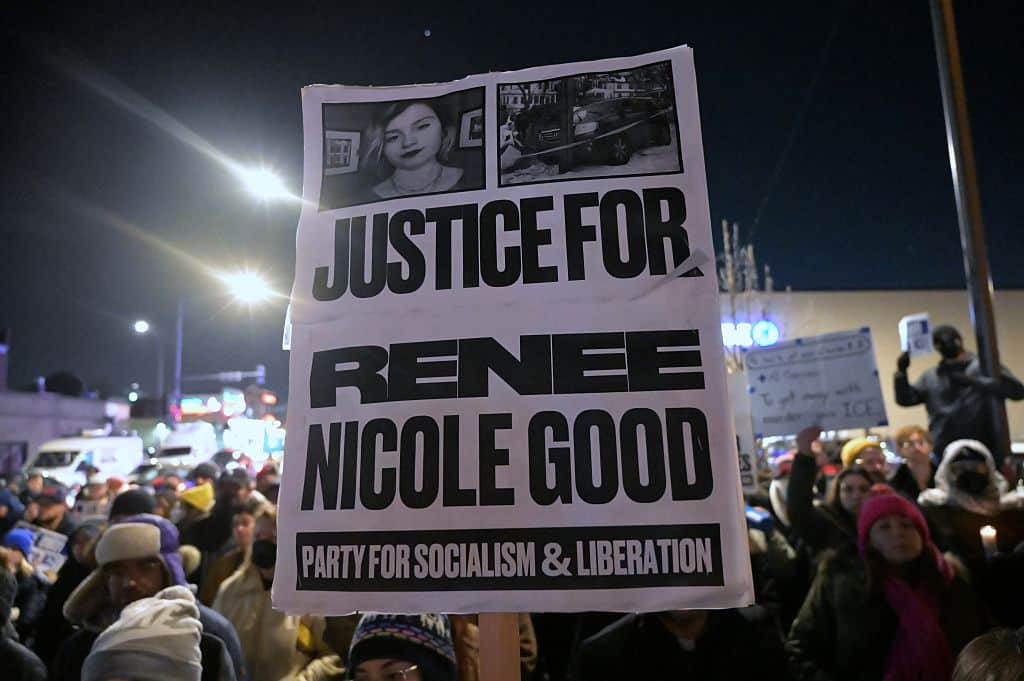
Renee was a poet, a writer, and a devoted mother. On social media, she once described herself as a “poet and writer and wife and mom and guitar strummer,” capturing a life rooted in creativity and connection. She had studied creative writing and earned recognition for her poetry, and friends say she was warm, welcoming, and deeply engaged with the people around her.
Neighbors recall seeing her play outside with her son, laughing and interacting with the children and pets nearby. Others who met her only briefly have shared stories of being welcomed into her home and made to feel instantly comfortable.
In a statement released through Minnesota Public Radio, Renee’s wife, Becca, addressed the overwhelming public response and spoke directly about who Renee was beyond the headlines.
She described her wife as someone who “sparkled,” radiating kindness without effort, and living by the belief that compassion is something to be actively nurtured. Renee, she said, believed that all people deserve care, safety, and love — values she and her wife were trying to pass on to their child.
That belief now stands in painful contrast to the way Renee’s life ended.
The shooting occurred at a neighborhood intersection, a place Renee likely drove through countless times before. What remains is a grieving family, a child who lost his mother, and a community grappling with questions that have no easy answers.
As investigators continue their work and public debate intensifies, one reality is already clear: a woman left home that morning expecting to return. She did not. And the ordinary life she was living — as a mother, partner, neighbor, and artist — has been reduced, for now, to a moment that ended far too soon.
