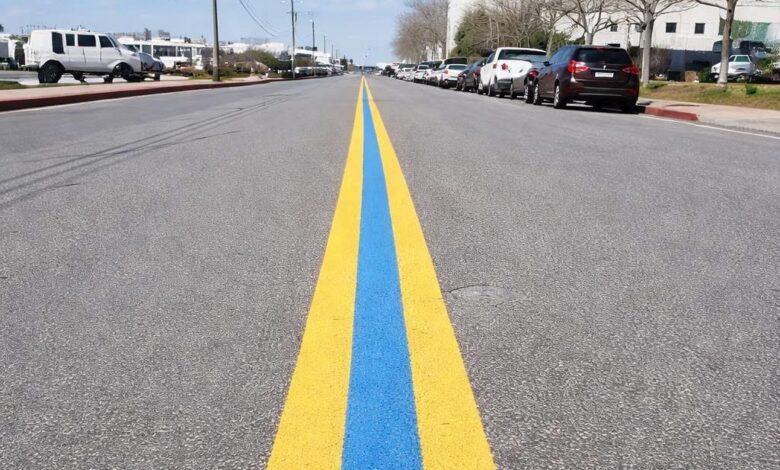
In the ever-evolving landscape of American infrastructure, road markings have traditionally served a strictly utilitarian purpose. The double yellow lines, the dashed white dividers, and the solid shoulders are the silent conductors of traffic, designed to ensure safety, predictability, and order. However, a new and visually striking addition is beginning to appear on the asphalt of select American municipalities, signaling a shift from pure utility to a form of civic communication. Drivers in various regions are noticing a thin, vibrant blue line painted carefully between the standard yellow center stripes. While at first glance it might appear to be a maintenance error or a temporary construction mark, the “thin blue line” on the roadway is a deliberate and symbolic gesture intended to bridge the gap between local government, the community, and the law enforcement officers who serve them.
The genesis of this initiative can be traced back to a growing desire among civic leaders to find visible, permanent ways to express appreciation for public safety professionals. One of the most prominent examples of this movement has taken root in Ocean City, Maryland, a town that experiences a dramatic seasonal transformation. Known as a premier beach destination, Ocean City sees its population swell from a few thousand permanent residents to hundreds of thousands of visitors during the peak summer months. This influx creates a unique set of challenges for local government, placing an immense logistical and security burden on the local police department. In response, city officials decided to implement a tribute that was as durable as the service it sought to honor.
The placement of the marking was a matter of strategic intent rather than random selection. In Ocean City, the blue line was applied to the pavement of 65th Street, a thoroughfare that serves as the primary artery leading directly to the municipal police headquarters. Mayor Rick Sheehan, an outspoken advocate for the project, framed the initiative not just as a decorative addition, but as a public declaration of the city’s values. According to Sheehan, the success of Ocean City as a tourist hub is inextricably linked to the sense of safety provided by its officers. By placing this symbol on the very road that officers travel to reach their station, the town has created a daily visual reminder of the community’s support. It is a “thank you” rendered in industrial-grade paint, designed to withstand the wear of thousands of vehicles and the salt air of the Atlantic coast.
The symbolism of the “thin blue line” has long existed in the form of flags, decals, and patches, where it traditionally represents the concept of the police as the barrier between social order and chaos. By moving this symbol onto the public right-of-way, municipalities are integrating that sentiment into the physical fabric of the town. Supporters of the movement argue that in an era often defined by social friction and complex debates regarding the role of policing, a visible gesture of goodwill can act as a stabilizing force. It is an effort to foster “civic unity”—a term frequently used by community leaders to describe the mutual respect necessary for a town to function effectively. The logic is that when a community visibly acknowledges the efforts of its public servants, it creates a more positive environment for both the officers and the citizens they protect.
Beyond the philosophical and symbolic layers, there is a surprising practical dimension to the blue line that city planners have been quick to highlight. In an age of GPS and digital navigation, physical landmarks still play a crucial role in spatial awareness. The blue line serves as an intuitive, low-tech navigational aid, effectively “threading” the path to the police station for anyone who might be in distress or seeking assistance. For a visitor unfamiliar with the layout of the town, the distinctive color provides a clear, followable trail to a place of safety. This blending of tribute and utility is what makes the project particularly appealing to municipal governments; it is a cost-effective way to enhance public awareness while simultaneously making a profound social statement.
The trend has not gone unnoticed by neighboring jurisdictions, and the “blue line movement” is beginning to inspire interest from other towns looking to bolster their own sense of community identity. In various city council meetings across the country, the Ocean City model is being cited as a template for constructive engagement. Proponents argue that such markings are non-intrusive and do not interfere with the standard regulations governing road safety, as they are nestled between the existing dividers rather than replacing them. This allows the tribute to exist in harmony with federal and state transportation guidelines, providing a unique local touch to what is usually a highly standardized environment.
Critics and observers of urban design note that the introduction of such markings reflects a broader trend toward the “personalization” of public spaces. As cities move away from purely functional architecture toward designs that reflect local history, values, and gratitude, the very ground beneath our tires becomes a canvas for community expression. The blue line is a reminder that the people who work behind the scenes—the dispatchers, the patrol officers, the investigators—are an integral part of the neighborhood’s infrastructure. It humanizes the bureaucracy of public safety, reminding the driver that the road doesn’t just lead to a destination, but is maintained and protected by members of their own community.
The long-term impact of these markings remains a subject of positive speculation among social scientists and urban planners. Some suggest that visible signs of appreciation can lead to higher morale among public safety employees, which in turn can lead to better community relations and job performance. Others believe that it encourages a “culture of gratitude” within the citizenry, prompting people to consider the essential services they often take for granted. Whether viewed through the lens of psychology, navigation, or simple civic pride, the blue line represents a creative departure from the status quo of municipal management.
As we move deeper into 2026, it is likely that more “blue paths” will emerge across the American map. They stand as a testament to the fact that even a modest amount of paint can carry a heavy weight of meaning. In the quiet hours of the night, when the headlights of a patrol car sweep over the blue pigment on 65th Street, the message is clear: the community sees the work being done, and they have marked the path to show it. It is a simple, effective, and enduring way to ensure that the “thin blue line” is not just a concept, but a tangible part of the landscape that brings people together.
The story of the blue road marking is ultimately one of connection. It is about a town deciding that its streets should do more than just carry cars—they should carry a message of respect. By integrating this symbol into the daily commute of its residents, Ocean City and towns like it are ensuring that the values of public service and community appreciation remain at the forefront of the public consciousness, one mile at a time. This evolving feature of the American road serves as a quiet but powerful reminder that order, safety, and gratitude are the true foundations upon which every thriving community is built.
