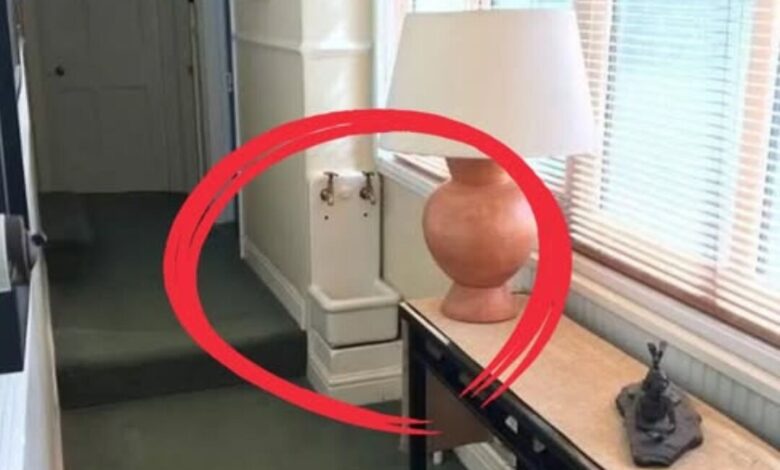
The architectural landscape of historic homes is often a tapestry of peculiar decisions and vanished necessities, leaving modern inhabitants to puzzle over features that once seemed indispensable. When walking through a residence built at the turn of the twentieth century, one might expect the familiar groaning of floorboards or the intricate woodwork of a sweeping staircase. However, a far more jarring sight often awaits in the corridors: a solitary, porcelain sink bolted to the wall in the middle of a hallway. It is not tucked into a powder room or hidden behind a door; it stands exposed between bedrooms or near the back entrance, looking to the uninitiated like a plumbing oversight or a misplaced relic from a Victorian hospital. Yet, these hallway sinks were far from a mistake; they were the high-tech hygiene hubs of their era, reflecting a profound shift in how humans interacted with their living spaces and the emerging science of sanitation.
To understand the existence of these “unexpected” sinks, one must first look at the state of domestic life in the late 1800s and early 1900s. During this period, the concept of indoor plumbing was transitioning from an extravagant luxury reserved for the ultra-wealthy to a hallmark of the modern middle class. In the early days of this transition, the “full bathroom” as we know it—a single room containing a toilet, sink, and tub—was not yet the standardized layout. In fact, many historic homes were originally constructed with only one bathroom, almost always located on the upper floor near the sleeping quarters. This created a logistical nightmare for a society that was still deeply rooted in manual labor and outdoor activity.
The hallway sink was born out of a desperate need for convenience and a growing obsession with “germ theory.” As the public became more aware of how diseases spread, the act of handwashing moved from a cosmetic ritual to a life-saving necessity. For a family living in a Victorian farmhouse or an early 20th-century city row house, the prospect of climbing a flight of stairs every time a hand needed rinsing was both impractical and messy. The hallway sink provided a “hygiene station” that allowed for a quick transition from the dirty world of the outdoors to the sanitized sanctuary of the home. It was the original mudroom, designed to capture dirt, soot, and bacteria at the threshold before they could be tracked into the parlor or the kitchen.
The utility of these fixtures was perhaps most appreciated by parents. In an era before paved suburban streets and manicured lawns, children spent their days in dirt, coal dust, and garden mud. The hallway sink allowed for a rapid “decontamination” process. Parents could supervise a quick cleanup without the chaos of a full bath, preventing the inevitable trail of footprints that would otherwise lead all the way to the second floor. These sinks were intentionally utilitarian; they often featured only a single cold-water tap and minimal piping, reflecting a design philosophy that favored function over form. They weren’t meant for shaving or long grooming sessions; they were meant for the brisk, cold-water rinse of a laborer coming in from the fields or a child coming home from school.
Furthermore, these sinks played a vital role in the morning routines of large households. With five or six people sharing a single upstairs bathroom, the “bottleneck” at the washbasin was a significant daily friction point. By installing a secondary sink in the hallway, the home’s “processing power” for morning hygiene was effectively doubled. One family member could brush their teeth or wash their face in the hall while another utilized the primary bathroom for more private matters. In this sense, the hallway sink was a precursor to the modern “jack-and-jill” bathroom or the contemporary en-suite, representing an early attempt to decentralize plumbing for the sake of efficiency.
The placement of these sinks also tells us a story about the materials and technology of the time. Because piping was expensive and difficult to install within existing walls, sinks were often placed where the plumbing stack was most accessible. This frequently resulted in the sink appearing in a “random” spot in a corridor because that was the most direct route for the water lines. What looks like an aesthetic blunder to a 2026 homeowner was, in 1910, a marvel of engineering that maximized the reach of a home’s water pressure with minimal invasive construction.
As we moved further into the 20th century, the “sanitary movement” continued to evolve, eventually leading to the creation of the dedicated half-bath or powder room. Once architects realized that people preferred to wash their hands behind a closed door, the exposed hallway sink began its slow decline into obsolescence. By the 1940s, new constructions had almost entirely moved toward the “multiple bathroom” model, and the hallway sink became a relic of a transitional period. Today, these fixtures are frequently misinterpreted by visitors. Some mistake them for “foot washers” or elaborate “spittoons,” while others assume they were intended for the help. In reality, they were a democratic feature used by every member of the family, a symbol of a household that valued both its time and its health.
In the modern real estate market, these sinks present a unique dilemma for those who purchase historic properties. Some renovators, eager for an open-concept look or more storage space, rip them out immediately, viewing them as clutter. However, a growing movement of historic preservationists views these sinks as “charming anomalies” that provide a tangible link to the past. Keeping a hallway sink is a way of honoring the “old-school style” of living—a reminder of a time when the arrival of running water was a cause for celebration and a simple porcelain bowl could revolutionize a family’s daily life.
Ultimately, the hallway sink is a testament to the fact that home design is never static; it is a living reflection of our changing values, fears, and technologies. What we consider an awkward plumbing error today was once the height of smart design. These fixtures serve as quiet monuments to a generation that was learning, for the first time, how to bring the power of the city’s water mains into the private intimacy of the home. They remind us that every feature of a house, no matter how strange it may seem, was once someone’s solution to a problem, and that the story of the human home is essentially a story of adapting our spaces to fit the ever-changing rhythms of our lives. When you encounter one of these sinks today, it isn’t just an old basin; it is a glimpse into a world that was just beginning to master the art of the modern clean.
