The ‘Redacted’ Truth: How Ted Lieu’s Forensic Interrogation Pinned Pam Bondi to the Epstein Files
WASHINGTON — In the wood-paneled halls of the House Judiciary Committee, where grandstanding often masks a lack of evidence, a recent 10-minute exchange has redefined the 2026 oversight cycle. Representative Ted Lieu, a former military prosecutor, moved beyond the rhythmic sparring of Washington to deliver what observers are calling a “forensic indictment” of the Department of Justice’s current posture on the Jeffrey Epstein archives.
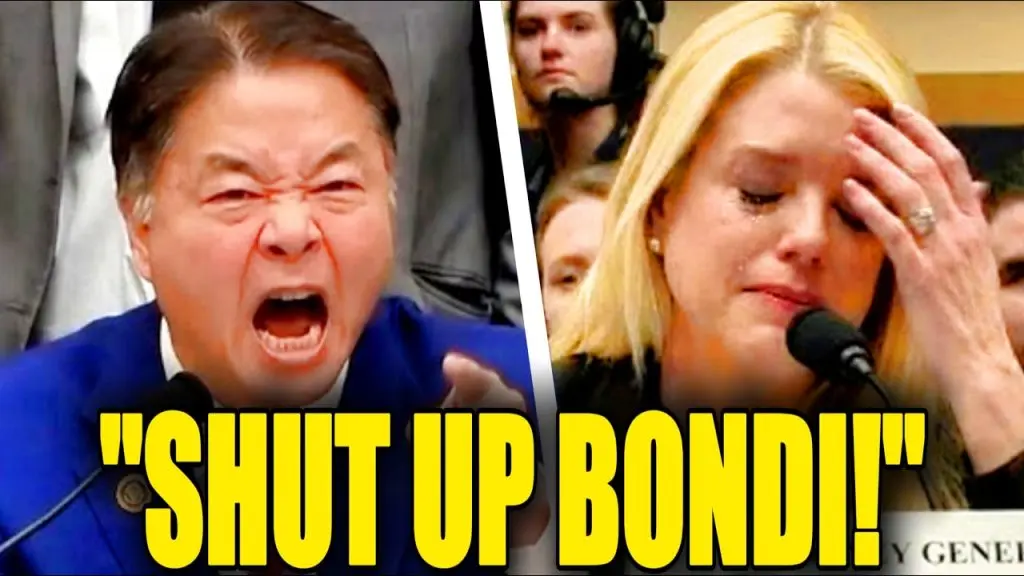
The confrontation, which has since dominated digital platforms and legal circles, centered on a fundamental contradiction: the DOJ’s insistence that it had uncovered “no evidence” to predicate investigations into uncharged third parties, contrasted against the specific, documented leads contained within the department’s own files.
The Evidence of the Photos
Lieu began his interrogation by projecting two photographs onto the chamber screens—images featuring a sex-trafficking victim alongside high-profile associates of Jeffrey Epstein, specifically former Prince Andrew. The strategy was surgical. By confirming that Bondi’s department had redacted the victim’s face in accordance with congressional law, Lieu forced the Attorney General to acknowledge the status of the individual in the photo as a verified victim of a federal crime.
“Under the Federal Victims Trafficking Protection Act, anyone who patronizes Epstein’s operation is guilty of a crime,” Lieu noted, his voice carrying the calm weight of a legal brief. “These two photos staring you in the face are evidence of a crime and more than enough evidence to predicate an investigation.”
The ‘Zero Indictment’ Record
The turning point of the hearing occurred when Lieu challenged a July 2025 DOJ memorandum which claimed that no evidence existed to pursue further associates. Bondi’s attempt to pivot the blame toward previous administrations—citing the failures of Merrick Garland, Bill Barr, and Alexander Acosta—was met with a sharp rebuke.
“I agree with you,” Lieu countered. “A whole string of failures. But you are in charge. You have the power to change things… and you’re doing the opposite. You’re protecting them.”
The visual of the Attorney General “shuffling empty pages” during the interrogation has become a potent symbol for critics who argue the department is in a state of “strategic paralysis.” Analysts note that despite a year in office and three million pages of evidence, the department has yet to hold a single man accountable from the newly released files.

The Uninterviewed Witness
Perhaps the most explosive revelation involved a witness who had reportedly called the FBI’s National Threat Operations Center with detailed allegations regarding interactions between Jeffrey Epstein and his associates. According to the record established during the hearing, the Department of Justice never interviewed this witness, despite the detailed nature of the information provided regarding alleged crimes involving high-profile names.
When Lieu accused Bondi of lying under oath regarding the “absence of evidence,” the Attorney General’s response shifted from procedural to personal. “Don’t you ever accuse me of a crime,” she fired back, a statement that observers noted failed to address the substance of the witness report or the lack of investigative follow-up.
Institutional Self-Protection
As the hearing concluded, the image left in the public mind was one of institutional self-protection rather than independent law enforcement. By refusing to answer whether specific leads were followed and instead relying on the “failings of predecessors,” the Attorney General has fueled the perception that the DOJ has evolved into a firewall for the powerful.
As history moves forward into the 2026 midterm cycle, the “Lieu Interrogation” stands as a permanent record of the gap between the DOJ’s rhetoric of transparency and its operational reality. For the 1,000 survivors mentioned in the hearing, the search for a justice system that prioritizes their testimony over political “decency” continues. The files are out, but as this hearing proved, the investigation appears to have stopped exactly where the names became too prominent to ignore.
