The Two-Seat Gap: Senator Blumenthal, Attorney General Bondi, and the Comey Indictment Timeline
The Senate Judiciary Committee is often a stage for high-stakes legal theater, but this week, the atmosphere shifted from abstract policy debate to a claustrophobic interrogation of physical geography. Armed with a single photograph, Senator Richard Blumenthal (D-CT) attempted to pierce the “Eiffel Tower of silence” surrounding the Department of Justice’s decision to indict former FBI Director James Comey. The confrontation, which focused on a White House cabinet dinner held the night before the indictment, has left Washington debating whether the Attorney General was acting as a servant of the law or a recipient of executive instructions.
The Social Media “Instruction”
Blumenthal began his interrogation by establishing a specific timeline. He noted that five days before James Comey was indicted, President Trump had published a social media post that Blumenthal characterized as a “direct instruction” to the Department of Justice. The post reportedly declared Comey and others “definitively guilty” and demanded immediate action—a move Blumenthal described as the “weaponization” of the DOJ.
When asked point-blank if she had discussed the indictment with the President following that post, Attorney General Pam Bondi deployed a practiced legal shield. “I am not going to discuss any conversations I have or have not had with the President of the United States,” she stated, citing her law degree as the basis for her refusal. It was a script she would maintain for the duration of the hearing, even as the evidence became more visceral.
The Dinner and the Photograph
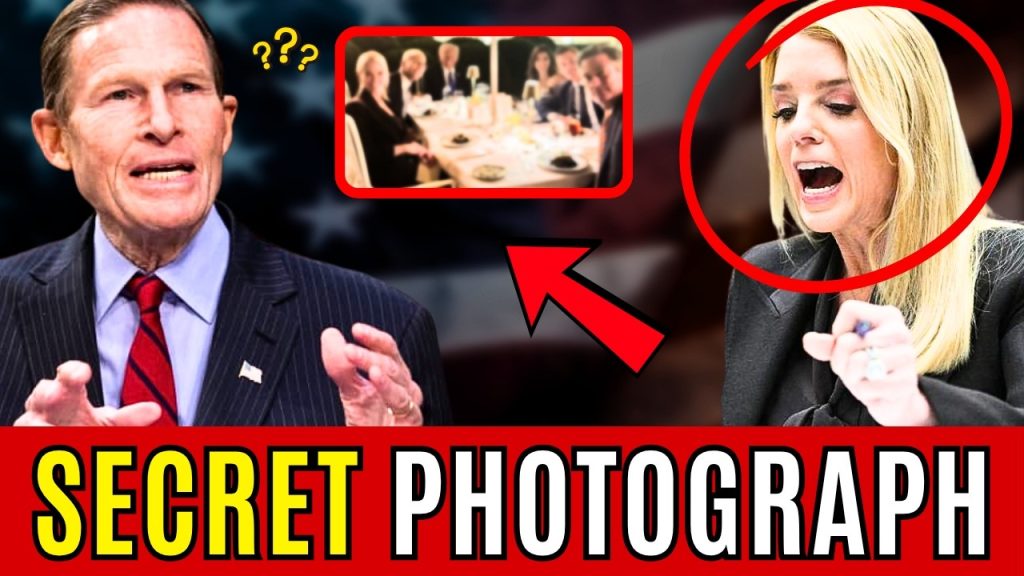
The dynamic of the hearing changed instantly when Blumenthal produced a photograph. The image captured a White House dinner held the night before Comey’s indictment. In the frame were the President, the Attorney General, and several other high-ranking officials.
“The night before James Comey’s indictment, you had dinner with the President of the United States. Pretty intimate group,” Blumenthal observed.
Bondi’s reaction was notable for its warmth toward the image itself. “I love that picture. That’s a great picture,” she remarked, before immediately using the scale of the event as a defensive perimeter. She noted that the “entire cabinet” was present, suggesting that a large, formal dinner was an improbable setting for a private strategy session regarding a criminal indictment.
Negotiating the Seating Chart

The sharpest moment of the exchange occurred when the debate moved from the fact of the dinner to the “geography of the table.” Blumenthal, aiming to reduce the distance between the two figures, asserted that the President was sitting “just to your left.”
Bondi provided a technical correction: “Two seats down.”
While seemingly a minor detail, the one-seat difference became the contested ground of the hearing. For Blumenthal, proximity implied conversation; for Bondi, the two-seat gap and the presence of dozens of other officials served as a rebuttal to the premise of a “targeted” discussion. Despite the correction, Blumenthal treated the Attorney General’s refusal to deny the conversation as a confirmation. “I’m going to take that as a yes,” he declared, a line that now sits in the permanent congressional record as a public conclusion drawn from a refusal to answer.
The Grand Jury Counter-Argument
Bondi’s primary defense against the allegation of political interference was not a denial of the dinner, but an emphasis on the legal mechanism of the indictment. She pointed out that James Comey was indicted by what she characterized as “one of the most liberal grand juries in the United States.”
Her logic was clinical: an indictment delivered by a grand jury with such an ideological character is evidence of a robust, independent process, not an instruction from the Oval Office. She argued that the instrument of the grand jury is the very proof of the “law enforcement and judicial process moving forward without political interference” that she had championed in her earlier remarks.
A Record Without Resolution
The exchange concluded as many Senate hearings do: with two parallel assertions that fail to resolve each other. Blumenthal asserted that the combination of a public social media “instruction,” a high-level dinner, and a well-timed indictment required an explanation that the American public is “entitled to know.” Bondi asserted that the legal independence of the grand jury rendered the President’s tweets and dinner seating irrelevant to the outcome of the case.
As the 2026 political cycle accelerates, the photograph of that dinner remains a “fulcrum” of the debate over DOJ independence. While the public may never know the exact words exchanged “two seats down” from the President, the visual of the Attorney General in the room the night before a major political rival was indicted has become a permanent feature of the national conversation. For now, the “Eiffel Tower of silence” remains standing, but it has a very specific seating chart attached to it.
