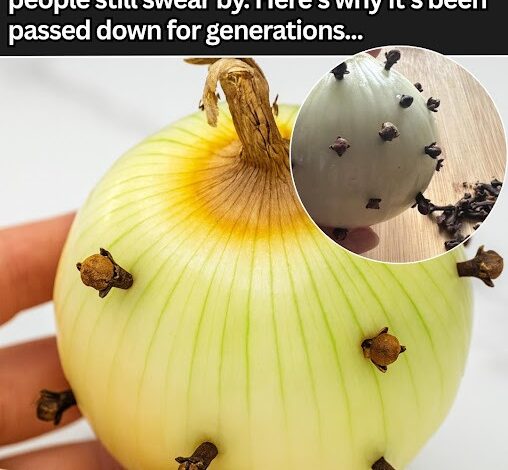
People have been passing down strange home remedies for generations, and few are as persistent as the old trick of sticking whole cloves into a peeled onion and leaving it out overnight to “cure a cold.” It sounds odd, it smells strong, and it definitely sparks debate. But for many families, it wasn’t just a quirky habit — it was a comforting ritual when someone felt sick. Today, it lives in that blurry space between folklore and kitchen-table science, where tradition meets a bit of chemistry and a lot of human hope.
The method is simple. You peel a white or yellow onion, press half a dozen or more whole cloves into it like you’re studding a ham for the holidays, and then you leave it on a plate near your bed or in the room of the person who’s under the weather. By morning, the air smells sharp and spicy, and some swear it feels lighter, easier to breathe. The idea behind it is straightforward: onions release potent sulfur compounds, cloves release eugenol and other antiseptic oils, and together they supposedly “purify” the air and ease congestion.
People have claimed for decades that an onion–clove combo can absorb germs from the air, pull sickness out of the body, break up mucus, and help you sleep when a cold hits hard. But before diving into the big promises, it’s worth understanding what’s actually happening — and what isn’t.
Onions themselves do have antimicrobial properties. They contain sulfur compounds and antioxidants like quercetin, which, in laboratory conditions, can inhibit bacteria such as E. coli and Staphylococcus aureus. Historically, onions were hung in sickrooms as early as the 1500s, and even during the 1918 flu pandemic, people believed hanging vegetables around the house would “draw out” dangerous miasmas. They were wrong about how illness spreads, but not entirely wrong that onions release compounds capable of irritating and stimulating the airways in ways that can feel helpful.
Cloves come with their own long list of abilities. Their star compound, eugenol, has been used for centuries in dentistry because it’s both antiseptic and numbing. It can fight bacteria, fungi, and some viruses in controlled environments, which is why clove oil shows up in everything from mouthwashes to natural cleaners. Even in whole form, cloves slowly emit aromatic oils into the air, which can have a mild clearing effect on the nose and throat.
The trouble comes from the old belief that onions “absorb” germs in the room. They don’t. No food pulls viruses out of the air or out of your body. Germs don’t magically jump onto produce like metal filings to a magnet. At best, the onion releases moisture and volatile compounds into the air that may slightly soothe irritated sinuses. At worst, if left out too long, it can grow bacteria on its own from normal household exposure. So while the onion-and-cloves setup might make the room smell different or feel more humid, it’s not vacuuming illness from the air.
Still, the experience itself can bring real, noticeable effects. Strong scents can open up the nasal passages the same way menthol does. The humidity from the cut onion can make dry rooms feel more comfortable when you’re congested. The combination of smells can cover up stale or sickroom odors, which makes the environment feel fresher. And never underestimate the psychological comfort of a familiar ritual — the human brain is wired to respond to signals of care, attention, and routine. Feeling cared for genuinely helps the body relax, which helps recovery.
But there are limits, and they matter. This trick will not cure a cold, treat the flu, reverse infections, or replace medical care. It won’t fight viruses inside the body. It won’t protect you from getting sick. It won’t “draw out toxins,” another popular myth. And the onion absolutely should not be eaten afterward. Once it’s been sitting open to the air for a day, it’s a sponge for dust and bacteria — the opposite of something you want in your body.
If you want to try this remedy safely, keep it simple. Use a fresh onion and whole cloves, insert them cleanly, and place the onion on a dish in a bedroom — not in the kitchen and not near food. Throw it away after 24 hours, wash your hands, and clean the dish. Treat it as aromatherapy, not medicine.
If you’re actually aiming for something that clears congestion in a measurable way, there’s a better option: make a pot of steam. Simmer onion, garlic, cloves, and ginger in water, then breathe in the warm vapor for five to ten minutes. Steam inhalation has been shown to ease swelling in the nasal passages and loosen mucus. It doesn’t cure the illness, but it can offer real relief. Many cultures around the world use some version of this practice, and unlike an onion sitting silently on a dresser, this one has a little more physiological logic behind it.
The onion-and-cloves remedy survives for one big reason: people trust what their families taught them. These traditions comfort us when we feel helpless. They remind us of childhood, caretaking, and the universal experience of nursing someone through a bad cough or stuffy nose. A remedy doesn’t have to be scientifically perfect to have value — it just needs to offer comfort without creating harm.
And that’s the truth here. This isn’t magic, and it isn’t useless. It’s a soft, harmless ritual with a bit of science and a lot of nostalgia behind it. Use it if it brings you peace. Just use real medical care alongside it. The best healing often comes from blending old wisdom with modern knowledge — a little aroma from the past, a little medicine from the present, and a lot of rest in between.
