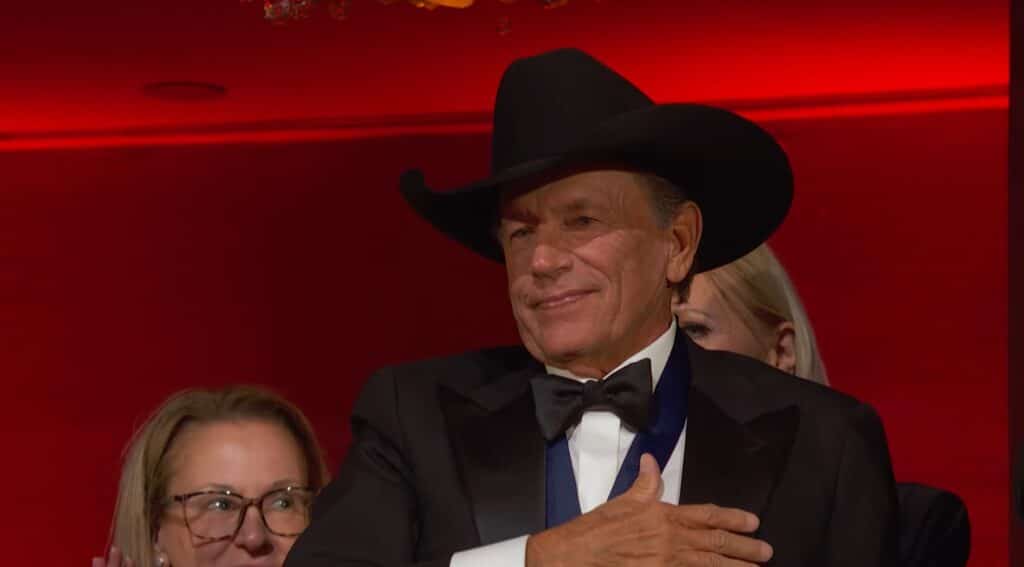
The undisputed King of country music.
Several weeks ago, the annual Kennedy Center Honors ceremony took place in Washington, D.C., recognizing George Strait alongside cultural heavyweights like KISS, Sylvester Stallone, Broadway legend Michael Crawford, and disco icon Gloria Gaynor. It was only fitting that the man widely known as the King of Country Music took his place among them.
The Kennedy Center—recently renamed the Trump-Kennedy Center—remains one of the most prestigious cultural institutions in the country. While President Donald Trump did not attend the Honors during his first term, he has taken a more active role in his second, appointing country artist Lee Greenwood to the board and restructuring the organization’s leadership. Still, the focus of the evening stayed where it belonged: on honoring artistic legacy.
Located in Washington, D.C., the Kennedy Center is a living memorial to President John F. Kennedy and a stage that has celebrated generations of musical greats. Country legends previously honored include Dolly Parton, Willie Nelson, Johnny Cash, Loretta Lynn, Merle Haggard, George Jones, and many others. George Strait now rightfully joins that company.
Strait’s resume speaks for itself. With an unmatched 60 No. 1 singles, he is the most successful hitmaker in country music history. He helped usher in the neotraditional country movement in the 1980s, pulling the genre back toward its roots at a time when it was drifting away from them.
His rise, however, was anything but calculated. Strait joined the Army in the early 1970s, and during his service auditioned for a band called the Country Kings—a name that feels almost prophetic now. He made it through one show before being told he “wasn’t country enough,” a story that feels almost impossible to believe in hindsight.
Undeterred, he found another opportunity playing with a band called Rambling Country, made up of fellow soldiers. After leaving the Army in 1975, Strait returned to school at Southwest Texas State University, earning a degree in agriculture in 1979. Just two years later, everything changed.
In 1981, he released his major-label debut single, “Unwound,” written by Dean Dillon and Frank Dycus. The song reached No. 6 on the Billboard Hot Country Singles chart, marking his first Top 10 hit—and the beginning of one of the most legendary careers music has ever seen.
Raised by his father on a 2,000-acre farm, Strait came from modest beginnings. That grounding has never left him. During interviews filmed for the Kennedy Center Honors special, he expressed genuine awe and gratitude for the tribute performances delivered by Miranda Lambert and Brooks & Dunn.
“I was blown away,” Strait said, thanking the artists for traveling to honor his music. “They did an amazing job.”
Reflecting on his career, Strait described it as “unbelievable,” admitting that he never imagined standing on a stage like this or receiving such recognition.
“When I signed my record deal in 1981, I would’ve never believed I’d be here,” he said. “I never really had a plan. I just tried to sing the best songs I could, make the best records I could, and put on the best shows I could.”
That humility is as much a part of George Strait’s legacy as the music itself. Few artists have accomplished more while remaining so grounded, gracious, and unassuming. It’s why the nickname “The King” has always fit—not just because of his success, but because of the way he’s carried it.
George Strait didn’t chase greatness. He earned it by staying true to the music, the songs, and himself. And there’s no one more deserving of this honor.
Long live the King.
Miranda Lambert delivered a flawless rendition of “Run,” and Brooks & Dunn paid tribute with a powerful performance of “Amarillo By Morning”—a perfect salute to a career that defines country music at its very best.
