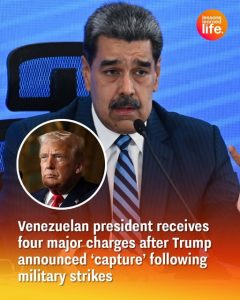
The story broke with the force of a shockwave—and just as much uncertainty. According to dramatic reports circulating overnight, Venezuelan President Nicolás Maduro had been captured by U.S. forces following alleged military action in Caracas. Videos purporting to show strikes on the Venezuelan capital spread rapidly across social media, blurring the line between verified information, official statements, and speculation as events appeared to unfold in real time.
Fueling the confusion, former U.S. President Donald Trump posted on Truth Social claiming that the United States had conducted a large-scale operation resulting in the capture of Maduro and his wife, Cilia Flores, and that both had been removed from Venezuela. Trump asserted that the mission involved coordination with U.S. law enforcement and promised further details at a forthcoming press conference. At that stage, however, independent confirmation remained limited.
Amid the swirl of claims, U.S. Attorney General Pam Bondi announced that Maduro had been indicted in the Southern District of New York. She outlined a sweeping set of charges, including narco-terrorism conspiracy, cocaine importation conspiracy, possession of machine guns and destructive devices, and conspiracy to use such weapons against the United States. Bondi framed the case as a long-standing law-enforcement effort, emphasizing that Maduro would face American courts. She did not, however, specify whether formal charges had been filed against Flores.
Bondi praised what she described as a successful operation against alleged international narcotics traffickers, underscoring the administration’s portrayal of the episode as a national security and criminal justice matter. Yet crucial details—particularly the circumstances of Maduro’s alleged capture—were left unaddressed, contributing to the atmosphere of uncertainty.
In Caracas, the response was immediate and tense. Venezuelan Vice President Delcy Rodríguez said the government had no verified information about Maduro’s whereabouts and demanded proof that both he and Flores were alive. The absence of direct confirmation only heightened anxiety and speculation inside the country.
Defense Minister Vladimir Padrino López described the reports as the most severe act of aggression Venezuela had ever faced. Calling for national unity, he said the armed forces were on alert and acting under Maduro’s authority, signaling preparations for heightened resistance should the situation escalate further.
As of now, the episode remains defined as much by claims and counterclaims as by confirmed facts. What is clear is that the reports—whether ultimately substantiated or not—have intensified regional and international tensions, revealing how quickly information, power, and perception collide in moments of geopolitical crisis.
