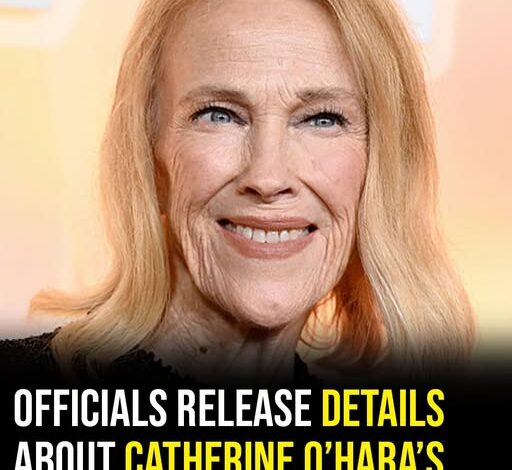
The world of entertainment has lost one of its most luminous and versatile stars. Catherine O’Hara, the Emmy-winning actress and comedic virtuoso whose career spanned decades and redefined the boundaries of character acting, has passed away at the age of 71. Her death, confirmed by her management on Friday, January 30, 2026, has sent shockwaves through the global creative community, leaving fans and peers alike to mourn the loss of a woman who was, quite simply, a comedic institution.
While the specific medical details of her passing have not been fully disclosed to the public, her manager indicated that O’Hara succumbed to a “brief illness.” The timeline of the tragedy began in the early morning hours of Friday, when local emergency services were dispatched to her residence in the quiet, tree-lined neighborhood of Brentwood, California. Paramedics reportedly arrived at the home at approximately 4:48 a.m. following a 911 call reporting a medical emergency. Authorities described her condition as “serious” upon their arrival, and she was swiftly transported to a major Los Angeles hospital. Despite the best efforts of medical staff, the actress who gave the world so much laughter passed away later that morning, surrounded by the echoes of a life lived with immense creativity and grace.
Catherine O’Hara’s legacy is a tapestry of iconic performances that bridged the gap between generations. To many, she will forever be Kate McCallister, the panicked yet fiercely determined matriarch in the “Home Alone” franchise. Her portrayal of a mother desperately trying to reunite with her son during the holidays became a foundational element of the modern Christmas canon. Decades later, she achieved what few actors ever do: a total career reinvention that captivated a whole new era of viewers. As Moira Rose in “Schitt’s Creek,” O’Hara created a character of such eccentric brilliance—defined by an unrecognizable accent, an army of wigs, and a theatrical soul—that she became a cultural phenomenon. Her work on the show earned her a sweep of every major television award, including an Emmy for Lead Actress, cementing her status as a master of the craft.
The news of her passing triggered an immediate and visceral outpouring of grief from those who worked alongside her. Perhaps the most poignant tribute came from Macaulay Culkin, who played her onscreen son, Kevin McCallister. Taking to social media, Culkin shared a hauntingly beautiful message that reflected the deep, maternal bond they had maintained long after the cameras stopped rolling. “Mama,” he wrote, “I thought we had time. I wanted more. I wanted to sit in a chair next to you. I heard you. But I had so much more to say. I love you. I’ll see you later.” The brevity and raw emotion of his words mirrored the sentiments of millions who felt they had grown up under the warmth of O’Hara’s presence.
O’Hara’s career began in the fertile ground of Second City in Toronto, where she honed the improvisational skills that would become her trademark. She was a foundational member of “SCTV” (Second City Television), where she collaborated with other legends like Eugene Levy, Martin Short, and John Candy. Her ability to disappear into a character—whether it was the high-glamour, low-logic Lola Heatherton or the wide-eyed innocence of her various sketch personas—set a gold standard for character work. She was a “writer’s actress,” someone who could take a single line of dialogue and find fifteen different ways to make it hilarious, often choosing the most unexpected and daring path.
Her filmography was as diverse as her talent. Beyond the blockbuster success of “Home Alone,” she was a frequent collaborator of director Tim Burton, providing the voice of Sally in “The Nightmare Before Christmas” and playing the delightfully pretentious Delia Deetz in “Beetlejuice.” She was also a staple of Christopher Guest’s mockumentary universe, delivering standout performances in “Waiting for Guffman,” “Best in Show,” and “A Mighty Wind.” In these films, she displayed her unique ability to play characters who were simultaneously absurd and deeply human, finding the pathos in their delusions and the comedy in their sincerity.
In her personal life, O’Hara was known for being remarkably grounded despite her immense fame. She is survived by her husband of over thirty years, the acclaimed production designer Bo Welch, and their two sons, Matthew and Luke. Her marriage was often cited as one of the most stable and enduring in Hollywood, a testament to her character off-screen. Colleagues frequently described her as a generous scene partner and a mentor to younger comedians, someone who approached her work with a “fearless silliness” that encouraged everyone around her to take bigger risks.
As the sun sets on the life of Catherine O’Hara, the entertainment industry is forced to reckon with the absence of a truly singular voice. She was an artist who refused to be pigeonholed, transitioning seamlessly from sketch comedy to family blockbusters to sophisticated satirical television. She taught us that humor could be found in the most frantic moments of motherhood and the most ridiculous heights of vanity. Her characters were more than just roles; they were vibrant, living entities that became part of our collective cultural vocabulary.
The silence left by her passing is profound, but her work remains. Every time a family sits down to watch a young boy defend his home, every time a fan quotes Moira Rose’s inimitable pronunciations, and every time an aspiring comedian watches old “SCTV” tapes to learn the art of the “straight-faced absurd,” Catherine O’Hara will be there. She was a woman who understood that life is often a strange mix of tragedy and comedy, and she navigated both with an elegance that few could hope to match.
In the coming days, more details regarding a memorial service are expected to be released. For now, the world remains in a state of quiet reflection, honoring a woman who spent seventy-one years making the world a significantly funnier and more interesting place. Her “brief illness” may have taken her from the stage, but it cannot touch the indelible mark she left on the hearts of those she entertained. As Macaulay Culkin so simply put it, we all “wanted more.” But what she gave us was more than enough to last a lifetime.
