The door to the back office didn’t simply swing open. It gave way. The hinges groaned as if they understood resistance was pointless.
The sound carried through the cramped corridor, past the humming freezer units and the clatter of dishes, into a space where authority was usually assumed rather than challenged.
Daniel Whitmore stepped inside. He didn’t enter the way executives usually did—with noise, with an entourage, with rehearsed confidence meant to announce power.
He walked in the way gravity moves: quietly, inevitably, without apology. The room seemed to recalibrate itself around him.
Bryce Carter, the location manager, sat behind a scarred wooden desk littered with schedules, inventory sheets, and a half-empty cup of cold coffee.

His sweat-stained polo clung to him like a second skin. The clipboard in his hands wasn’t for organization anymore; it had become a shield, something solid to hide behind.
Without looking up, Bryce spoke. “Dining room’s that way, pal.”
The words came out automatically, coated in the casual arrogance of someone used to being obeyed in a small, carefully guarded territory. In this building, Bryce was king—or at least he believed he was.
Daniel didn’t move. “The dining room is that way,” Bryce repeated, sharper now, irritation creeping in. “Employees only back here.”
Daniel finally spoke, his voice low and even. “The dining room is a disaster, Bryce. And the kitchen smells like freezer burn.” The air shifted.
It wasn’t volume that made the sentence land. It was precision. The kind that told Bryce, instantly and unmistakably, that this man had already seen everything.
Bryce’s fingers stiffened around the clipboard. His mind scrambled, replaying the voice, searching memory for context. When it clicked, it hit hard. He looked up.
The color drained from his face so fast it was almost visible, like water being pulled from fabric. His expression collapsed from irritation into alarm, then into something closer to fear.

“Mr. Whitmore?” he said, standing too quickly. The chair legs screeched against the floor. “I— we weren’t expecting a site visit until next quarter. I have everything prepared. The spreadsheets, the labor reports. Costs are down twelve percent. Overtime is under control. We’ve been hitting targets—”
“I don’t care about your spreadsheets,” Daniel interrupted.
He reached into the inside pocket of his coat and removed a folded piece of paper. He placed it on the desk, flattening it with two fingers. “I care about why your staff is afraid to breathe.”
Bryce swallowed. Daniel tapped the paper once. “Jenna,” he said. “Talk to me about her.”
Cracks in the Kingdom
Bryce’s mouth opened, then closed. His brain raced ahead of his words, assembling explanations, rehearsed defenses, numbers he could throw like smoke bombs. He had survived audits before. He knew how to redirect, how to overwhelm.
“Jenna is… emotional,” Bryce said finally, forcing a laugh that sounded wrong even to himself. “Young. Still adjusting to the pace. Some people just aren’t cut out for high-pressure environments. We’re in food service, after all.”
Daniel’s eyes stayed on him, unblinking.
“She’s been here three years,” Daniel said. “Her performance reviews were consistent. Strong, actually. Until six months ago.”
Bryce’s laugh died. Daniel continued, calm and relentless.
“Six months ago, turnover in this location doubled. Sick days increased. Customer complaints shifted from wait times to staff attitude. You wrote that off as ‘market fatigue.’”
He leaned forward slightly. “I wrote it off as management failure.” Bryce felt the walls closing in.

“I run a tight ship,” he snapped, defensiveness breaking through. “People these days don’t like structure. They don’t like being held accountable.”
Daniel nodded once. “And yet your structure produces panic attacks in the walk-in freezer.”
Bryce froze. Silence stretched, heavy and suffocating. Before Bryce could form a response, the door creaked open behind Daniel. Someone had followed him.
The Breaking Point
Jenna stood in the doorway.
She was smaller than Bryce remembered noticing, but there was nothing small about the way she held herself. Her hands trembled, yes—but her shoulders were straight, her chin lifted in quiet defiance.
Her uniform was neat, though worn thin at the edges. Dark circles framed her eyes, evidence of too many nights spent replaying the same day.
She hadn’t been invited in.
In any other version of this story, stepping into that room would have been a career-ending mistake. Bryce would have written her up, cut her hours, found a reason to let her go. He had done it before.
But this wasn’t any other version. This was the one where the owner was standing between her and the door. Daniel didn’t turn around immediately. He already knew she was there.
“Jenna,” he said gently. “You don’t have to—” “Yes,” she said, her voice shaking but clear. “I do.” Bryce spun toward her. “What do you think you’re doing?” he barked. “Get back on the floor. Now.”
Daniel raised one hand. “No,” he said. “She stays.” Bryce stared at him, stunned. Daniel turned to Jenna. For the first time since entering the building, his expression softened. “You wrote the note,” he said.
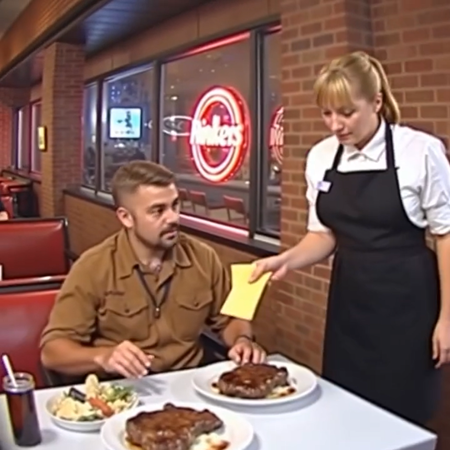
She nodded.
“I didn’t think you’d actually read it.” “I read everything,” Daniel replied. Jenna took a breath. Her fingers curled into fists at her sides.
“I didn’t write it because I want special treatment,” she said. “I wrote it because I can’t keep pretending this is normal.”
Bryce scoffed. “This is insubordination,” he said. “She’s exaggerating. She’s sensitive. We’ve had conversations about professionalism.”
Daniel looked back at him. “Then let her speak,” he said. “If she’s exaggerating, it will be obvious.” Bryce hesitated. Then, with a tight smile, he gestured dismissively. “Go ahead,” he said. “Tell your story.”
Truth Without Volume
Jenna didn’t raise her voice. She didn’t need to. She spoke slowly, carefully, as if choosing each word mattered—because it did.
“He yells,” she said. “Not just when things go wrong. When they go right. When we’re busy. When we’re slow. He yells because he can.” Bryce opened his mouth. Daniel lifted a finger.
“Let her finish.” Jenna swallowed and continued. “He schedules people short and tells us to ‘figure it out.’ He changes shifts without notice. If someone asks a question, he calls them stupid in front of customers. If someone cries, he says they’re weak.”
Her voice wavered but didn’t break.
“I used to love this job,” she said. “I trained half the staff. I covered shifts. I stayed late. I stopped doing all that when I realized it didn’t matter how hard I worked. It was never enough.”
Bryce’s face reddened. “This is workplace pressure,” he snapped. “This is reality. If you can’t handle it—”
“You threaten people’s hours,” Jenna said, looking directly at him now. “You tell them they’re replaceable. You make them feel like one mistake will ruin them.” Daniel’s jaw tightened.
Bryce turned to him, desperate. “Sir, you know how hard it is to manage people. You know the margins. You know—” “I know leadership,” Daniel said quietly. “And this isn’t it.”
Consequences
Daniel straightened and picked up the folded note again. “This wasn’t the only one,” he said. “It was just the one that finally made sense of the others.”
Bryce’s breathing grew shallow. “Effective immediately,” Daniel continued, “you’re suspended pending a full review. HR will contact you. Your access is revoked.”
“You can’t do this on a whim,” Bryce protested. “You’re overreacting.”
Daniel met his gaze.
“No,” he said. “I’m reacting late.” He turned to Jenna.
“You did the right thing,” he said. “And I’m sorry it took this long.” Her eyes filled with tears, but she nodded.
“I just wanted it to stop,” she said. Daniel gave a small, firm smile.
“It will.”
Aftermath
As Bryce was escorted out, the building felt different.
Quieter. Lighter. Not because a tyrant had fallen, but because someone had finally listened.
Jenna remained in the office, unsure what came next. Daniel didn’t rush her.
“You’re not in trouble,” he said. “And you’re not alone.” For the first time in months, she believed it.
