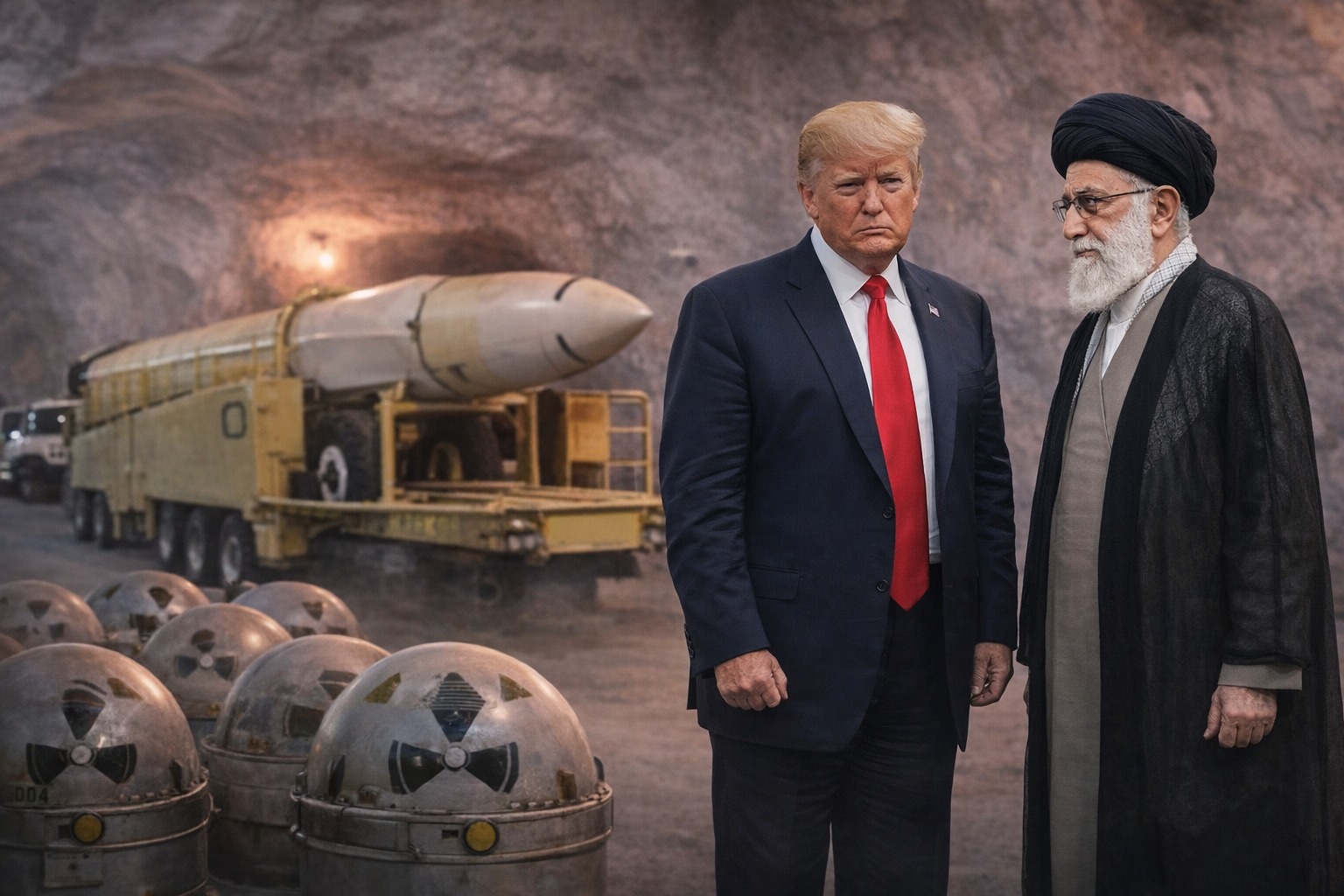
Iran has spent decades developing one of the most extensive missile programs in the Middle East. Analysts widely view this arsenal as a central element of the country’s military deterrence strategy, designed to compensate for limitations in conventional air power and to project influence across the region.
A Large and Diverse Missile Arsenal
According to assessments cited by United States Central Command, Iran is believed to possess more than 3,000 ballistic missiles of various types. That estimate places it among the largest missile inventories in the region.
Iran’s missile forces include systems with different ranges and purposes. Short-range ballistic missiles are designed primarily for targets within neighboring regions, while medium-range systems expand the potential reach of Iran’s deterrent capability.
Short-Range Missile Systems
Among the most widely referenced Iranian missiles are members of the Fateh missile family and the Zolfaghar missile. These weapons are intended for relatively nearby military targets and are often described as capable of rapid launch sequences.
Launching multiple missiles in quick succession can complicate an opponent’s defense systems by forcing them to intercept numerous incoming projectiles simultaneously. Military analysts refer to this approach as saturation or volley tactics.
A prominent example occurred in 2020 after the killing of Qassem Soleimani, when Iran launched missiles toward U.S. military facilities in Iraq. The strikes were widely interpreted as a demonstration of Iran’s ability to conduct coordinated missile attacks.
Medium-Range Strategic Missiles
Beyond short-range systems, Iran operates several medium-range ballistic missiles that form the backbone of its strategic capability. These include the Shahab-3, Khorramshahr missile, and Sejjil missile.
Many of these missiles are estimated to have ranges of up to roughly 2,000 kilometers, placing large portions of the Middle East within reach.
Iranian officials have stated that this range reflects the current limits of their program. However, Western analysts often note that the underlying technology could theoretically support longer-range systems if further development occurs.
Emerging Technologies and Hypersonic Claims
In recent years, Iranian authorities have also discussed the development of more advanced systems. One project frequently mentioned in official statements is the Fattah hypersonic missile.
Iranian officials claim that such missiles could maneuver at extremely high speeds and potentially evade some existing air-defense systems. Independent verification of specific performance claims, however, remains limited, and defense experts continue to debate their capabilities.
Cruise Missiles and Low-Altitude Systems
Iran’s arsenal is not limited to ballistic missiles. The country has also developed cruise missiles that travel at lower altitudes and can be harder for radar systems to detect.
One commonly cited example is the Soumar cruise missile, which analysts believe may be derived in part from the Soviet-era Kh-55 cruise missile.
These systems add flexibility to Iran’s deterrence strategy by providing different attack profiles and flight paths.
Underground “Missile Cities”
Another distinctive feature of Iran’s military infrastructure is the construction of extensive underground facilities often described as “missile cities.” These bases are designed to store and launch missiles while protecting them from airstrikes.
Satellite imagery and official videos released by Iranian authorities have shown large tunnel networks containing launch platforms, storage depots, and transportation corridors.
The goal of such facilities is to ensure that missile forces remain operational even if surface bases are targeted.
The Growing Role of Drones
Unmanned aerial systems have also become a significant component of Iran’s military strategy. Systems such as the Shahed-136 are relatively inexpensive compared with traditional missiles and can be produced in large numbers.
Because these drones can be launched in swarms, they may be used to overwhelm expensive air-defense systems like the MIM-104 Patriot.
Strategic Debate and Future Capabilities
Some officials have argued that military strikes in recent years significantly weakened parts of Iran’s missile infrastructure. However, satellite imagery and expert analysis suggest that Iran has been able to rebuild portions of its capabilities relatively quickly.
At present, U.S. intelligence assessments indicate that Iran does not yet possess intercontinental ballistic missiles capable of reaching the United States. Analysts generally estimate that such technology, if pursued, would take years to develop.
For this reason, Iran’s missile program remains a central topic in regional security debates, arms-control discussions, and diplomatic negotiations.
The program’s evolution continues to influence strategic calculations across the Middle East — where deterrence, technological competition, and geopolitical rivalry intersect in one of the world’s most closely watched security environments.
