The Two-Million-Page Shadow: Inside the Subpoena Showdown Over the Epstein Archives
WASHINGTON — In the high-stakes theater of the House Oversight Committee, the dry cadence of a roll-call vote on “Motion Number Two” has signaled a definitive rupture in the official narrative surrounding the Jeffrey Epstein files. By a bipartisan vote of 24 to 19, lawmakers have moved to compel Attorney General Pam Bondi to testify under oath, effectively declaring that the Department of Justice’s era of “selective transparency” has reached a dead end.
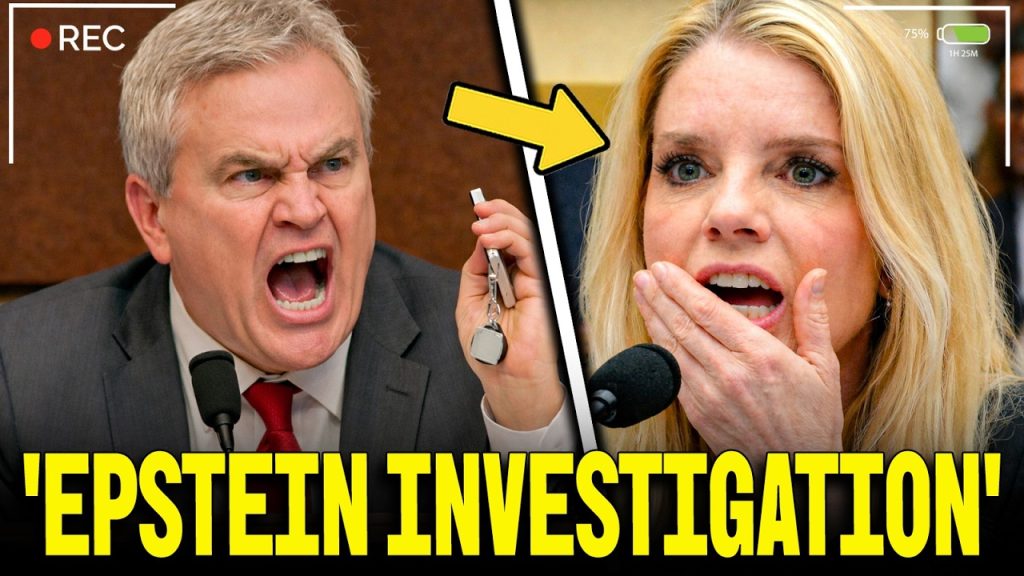
The confrontation, which has sent shockwaves through the capital’s legal and political circles, centers on a stark mathematical discrepancy: while the Department of Justice (DOJ) claims it has complied with the Epstein Files Transparency Act, it has produced only 33,000 pages of material to Congress—most of which was already in the public domain. Behind that thin volume, investigators allege, lies a “wall of ink” obscuring approximately 2.5 million pages of evidence that the department continues to withhold.
The ‘Perfect Storm’ of Skepticism
The push for a subpoena was catalyzed by a growing consensus among both Democrats and Republicans that the DOJ is prioritizing “political protection over legal obligation.” Representative Nancy Mace, one of the primary drivers of the motion, characterized the DOJ’s posture as a “deliberate attempt to obstruct a bipartisan investigation into child sex trafficking.”
The skepticism is grounded in forensic evidence that suggests the redaction process has been anything but neutral. During a recent hearing, Bondi was excoriated for a “haphazard” process that exposed the names and intimate details of survivors—including the release of nude photographs—while successfully and surgically redacting the names of high-profile individuals linked to the sex-trafficking network. This “accidental” exposure of victims versus the “disciplined” protection of the powerful has become the primary indictment of the department’s credibility.
The Shadow of William Barr
The committee’s case has been bolstered by the extraordinary testimony of former Attorney General William Barr, who provided a rare, unvarnished look at the “perfect storm of screw-ups” surrounding Epstein’s 2019 death at the Metropolitan Correctional Center. Barr admitted that a critical camera in the housing unit was transmitting in real-time but failed to record to the digital video recorder (DVR) just as Epstein was allegedly left unchecked by guards.
Barr further dismantled the “standard procedure” defense by admitting that the 2008 non-prosecution agreement in Florida—which protected unknown co-conspirators—was an unprecedented move that stripped victims of their rights. For current lawmakers, the 2026 battle is not just about a dead criminal, but about dismantling the institutional frameworks that allowed his network to operate for decades without consequence.
The ‘Burn Book’ and the Separation of Powers
Perhaps the most explosive allegation to emerge is the claim that the DOJ has turned its investigative tools against its own overseers. During her review of the files, Representative Pramila Jayapal discovered that the department was logging her specific search queries, a move she branded a “total violation of the separation of powers.”

Bondi was reportedly seen in the hearing room with a document labeled “Jayapal Pramila Search History,” listing at least eight specific files the Congresswoman had examined. This use of surveillance technology to monitor lawmakers has been characterized by Jaime Raskin as “Orwellian,” suggesting a department more focused on managing its monitors than its archives.
The Failure of Administrative Defense
Bondi’s primary defense—that the DOJ is working as fast as possible to review a historic volume of data—is being met with a wall of public and political dissatisfaction. A recent Fox News poll indicates that 68% of Americans believe the DOJ has not been transparent enough regarding the Epstein files, a sentiment that crosses traditional party lines.
The legal reality for the Attorney General is now shifting from a debate over transparency to a requirement for compliance. Under House Rule X, the Oversight Committee possesses broad authority to issue subpoenas that do not recognize common-law privileges, such as the “deliberative process” privilege, which the DOJ has frequently used to shield its records.
The Procedural Precipice
As the 30-day deadline for a response to the subpoena approaches, the Attorney General faces a binary choice: comply with the deposition or face the prospect of being held in contempt of Congress. The committee is also seeking the disclosure of taxpayer-funded misconduct settlements, linking the Epstein files to a broader effort to unmask institutional cover-ups across the federal government.
The upcoming deposition will force Bondi to answer, under penalty of perjury, why 2.5 million pages remain hidden and who, precisely, gave the order to track the movements of lawmakers inside the DOJ’s reading rooms. For a public that has waited years for the “full truth,” the subpoena is more than a legal document; it is a signal that the time for “procedural safeguards” has run out. In the 2026 political landscape, the record no longer belongs to the department—it belongs to the law.
