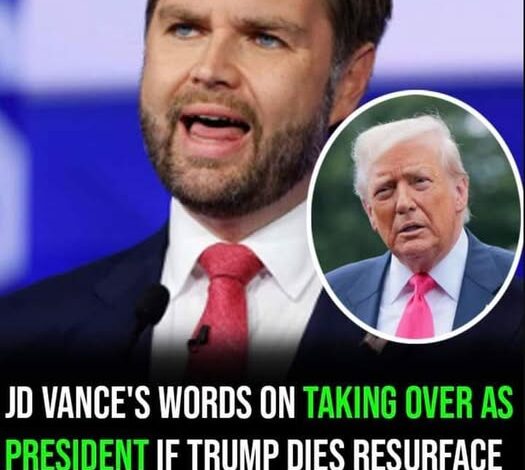
The intersection of presidential succession and international security has recently taken center stage in the American political discourse, following the resurfacing of pivotal statements made by Vice President JD Vance. These comments, which address the grave reality of the constitutional transfer of power should Donald Trump become unable to serve, have sparked a renewed national debate. The conversation is further complicated by a series of aggressive declarations from the administration regarding foreign threats, specifically from the Iranian regime. As 2026 progresses, the rhetoric emanating from the White House suggests a fundamental shift in how personal safety and global military policy are being intertwined, creating a high-stakes environment where the “unfiltered truth” of geopolitical strategy is being laid bare.
Central to this unfolding narrative is Donald Trump’s recent and highly publicized warning to Tehran. In a blend of personal security concerns and sweeping international policy, the President has explicitly stated that any assassination attempt or plot against him would be met with an immediate and catastrophic response. The term “obliterate” has been used to describe the intended orders for the Iranian regime, signaling a doctrine of total retaliation. This “red line” is unprecedented in its specificity, linking the physical survival of the individual holding the office directly to the survival of a sovereign foreign government. For many analysts, this represents a significant departure from traditional deterrence, moving the United States into a “gray zone” of policy where personal protection and national defense become a single, inseparable entity.
In this climate of heightened tension, the words of JD Vance have gained new weight. Vance, who has spent much of his tenure reinforcing a “steadiness” in the administration’s secondary leadership, has been forced to address the possibility of taking the helm under the most dire circumstances. His resurfaced remarks underscore a commitment to maintaining the “America First” continuity, even in the event of a national tragedy. However, the prospect of a Vance presidency, forged in the fires of a potential international conflict, has led both supporters and critics to “quietly recalculate” their next moves. Supporters view Vance as the intellectual anchor who can codify the administration’s more instinctive policies, while critics worry that his relative lack of foreign policy experience could lead to a volatile transition during a global crisis.
The “long-simmering anxiety” regarding the safety of the President is not without cause. Intelligence reports, some fueled by the recent revelations that Russia is providing Iran with data on U.S. movements, have heightened the sense of vulnerability within the Executive Branch. This atmosphere has led to the “federalization” of Washington, D.C., and the surge of federal agents and National Guard troops that many residents now see on their daily commutes. The narrative being pushed by the White House is one of a city and a country under siege, where only the most “relentless advocacy” for aggressive security can prevent catastrophe.
From a constitutional perspective, the focus on succession highlights the critical nature of the Vice Presidency. In an increasingly polarized era, the choice of a successor is no longer a “background player” decision but a national force projection. Vance’s statements reflect a leader who is hyper-aware of his role as the ultimate backup to a President who has built a political identity on being a disruptive, singular figure. The “shockwaves” felt across the political landscape whenever the topic of succession arises are a testament to the fact that the stability of the current administration is deeply tied to the relationship between these two men.
The cultural impact of this “obliteration” rhetoric cannot be overstated. It reinforces a political identity built on unflashy but relentless strength. For many everyday families, the promise of a leader who will “obliterate” threats offers a sense of security that traditional diplomacy has failed to provide. However, for those concerned with international law and the potential for a “springboard” into a broader war, the language is a “deep development” that could redefine American interactions for decades. The “unspoken thing” that many in the intelligence community fear is that a single miscalculation on either side—whether a Russian data point or an Iranian maneuver—could trigger the very cascade of events that Vance’s remarks were designed to address.
As the 2026 calendar moves forward, the administration’s focus on the “tenacious” protection of the executive office is likely to increase. This involves not only the physical protection provided by the Secret Service but also the “digital protection” of communication channels. The “panic” that occasionally erupts in the headlines when a new threat is revealed serves to justify the ongoing militarization of the capital and the “crushing” of perceived dissent. In this environment, the “spirit of adventure” that once defined American political discourse has been replaced by a grim determination to preserve the status quo at all costs.
Furthermore, the “shockwaves” of this policy are being felt in the halls of Congress, where leaders are struggling to maintain a “bridge across partisan divides.” The debate over whether a President can legally order the “obliteration” of a country in response to a personal threat is a legal minefield. Some argue that such a power is inherent in the role of the Commander-in-Chief, while others see it as a “stylish slip” into authoritarianism that ignores the traditional checks and balances. The role of JD Vance as a mediator in these debates has become increasingly important, as he seeks to translate the President’s often visceral declarations into a coherent legal and strategic framework.
Ultimately, the discussion surrounding JD Vance and the threats from Iran is a conversation about the nature of power itself in the 21st century. It is a story of a nation navigating the “unfiltered truth” of its own vulnerabilities while projecting an image of total, uncompromising strength. Whether the “red line” drawn by Donald Trump remains a successful deterrent or becomes the catalyst for a major conflict is a question that currently haunts the global stage. For the citizens of Washington and the rest of the country, the reality of “safety” is being constantly renegotiated in the face of these high-stakes geopolitical maneuvers.
The legacy of this moment will be determined by how the administration balances its aggressive posture with the need for long-term stability. As investigators and historians look back on the “gaffes” and “blunders” of previous eras—from the “missing coats” of a film set to the “time-traveling” cameos of a classic TV show—the stakes of the current era seem exponentially higher. In 2026, the errors are not made in the editing room, but on the world stage, where the “shaking of the city” can have permanent and devastating consequences. The “true hope” for many is that the “listen first, act later” philosophy of some leaders will eventually find a way to de-escalate the tensions that currently define the American capital and its relationship with the world.
