The Architecture of Inaction: Inside the Explosive Clash Over the Epstein Files
WASHINGTON — In the modern history of congressional oversight, few subjects possess the radioactive power of the Jeffrey Epstein investigation. On Thursday, that history reached a new and volatile flashpoint inside the House Judiciary Committee, where Representative Ted Lieu (D-CA) used a pair of redacted photographs to dismantle the Department of Justice’s narrative of completion.
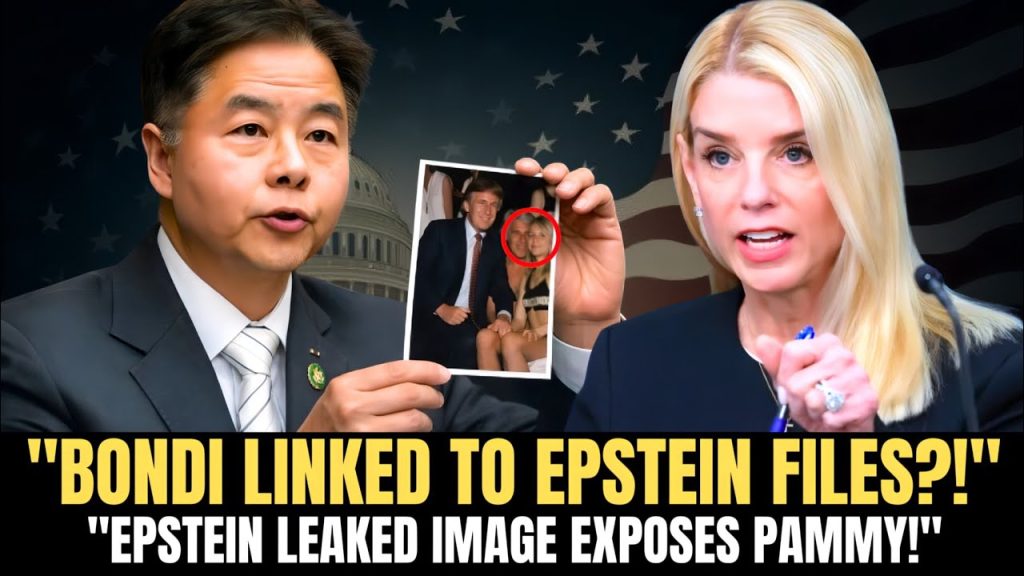
The confrontation with Attorney General Pam Bondi was not a debate over legal technicalities, but a forensic examination of institutional will. In a line of questioning that moved from high-profile figures to the testimony of a forgotten limousine driver, Mr. Lieu argued that the Department of Justice is not merely managing a case, but actively shielding a network.
The July Memorandum
The foundation of the clash was a Department of Justice memorandum dated July 2025. In that document, the department stated it had “not uncovered evidence that could predicate an investigation” against uncharged third parties. Bondi arrived at the hearing appearing prepared to stand by that conclusion, citing “prosecutorial discretion” and the “totality of evidence.”
The atmosphere shifted when Mr. Lieu produced two photographs into the record. The images, which showed former British Royal Prince Andrew at events connected to Epstein, had their victims’ faces redacted according to federal law.
“These two photos staring you in the face are evidence of a crime,” Lieu remarked, his voice carrying the flat, clinical authority of a former military prosecutor. “Not only is Jeffrey Epstein guilty, but anyone who patronizes Epstein is also guilty… Why did you shut down this investigation?”
The Limo Driver’s Statement
The hearing took a turn toward the specific and the graphic when Mr. Lieu introduced a witness statement reportedly submitted to the FBI’s National Threat Operations Center. According to the statement, a man who once worked as a limousine driver for Donald Trump and Jeffrey Epstein claimed to have overheard disturbing cell phone conversations between the two men.
The statement further alleged that the witness had encountered a woman who made serious accusations of violence involving both individuals—a woman who was later found dead under circumstances that local officers reportedly deemed “not a suicide.”
Lieu’s most cutting charge was not the allegation itself, but the lack of follow-up. “No one at the Department of Justice interviewed this witness,” Lieu noted. “You need to interview this witness immediately.” The implication was clear: the DOJ’s claim of “no evidence” was being maintained by a refusal to look at the evidence already in its possession.

The “No Evidence” Assertion
The Attorney General responded with visible indignation, characterizing the focus on Donald Trump as a “ridiculous” attempt to deflect from the administration’s achievements. Bondi maintained that “there is no evidence that Donald Trump has committed a crime,” and asserted that everyone in Washington “knows that.”
However, Lieu’s interrogation had already placed a series of counter-facts onto the official record: the photos, the July memo, and the unexamined witness statement. When Bondi suggested that previous attorneys general had faced similar questions, Lieu pivoted. “I agree with you,” he said. “A whole string of failures. But you are in charge… and you’re doing the opposite. You’re protecting them.”
A Crisis of Legitimacy
The confrontation reached its zenith when Mr. Lieu stated that he believed the Attorney General had “lied under oath” regarding the existence of evidence. The accusation momentarily stunned the room, prompting a sharp rebuke from Bondi: “Don’t you ever accuse me of a crime.”
Accusing a sitting Attorney General of perjury is perhaps the most serious allegation a member of Congress can make. It transforms a policy debate into a potential criminal matter, and in that moment, the hearing room felt the weight of a fundamental breakdown in trust between the legislative and executive branches.
The Unfinished Record
As the five-minute questioning period drew to a close, the “Special Relationship” between the public and its law enforcement institutions appeared significantly more strained than the official communiqués usually suggest. Mr. Lieu’s final message centered on the victims—more than 1,000 individuals identified in the core prosecution—who continue to wait for a system that looks beyond the traffickers to the enablers.
For the American public watching from home, the hearing confirmed a growing suspicion that the Epstein story did not end with his death in 2019. The “zero” charges against major associates in recent months stands as a stark symbol of an investigation that, despite its massive scale, appears to have left the most difficult doors unopened. As the gavel fell, the photographs and the witness statements remained on the table, forming a paper trail that the Department of Justice has yet to follow to its conclusion.
