What began as a routine congressional hearing quickly turned into one of the most explosive and unsettling confrontations Washington has seen in a long time.
Cameras were rolling, lawmakers were leafing through stacks of documents, and survivors tied to the Epstein scandal sat silently just feet away from the nation’s top law enforcement official.
That image alone gave the hearing unusual gravity.
This was not just another political argument about procedure, but a deeply emotional clash over secrecy, power, redactions, and the lingering belief that the full truth is still being withheld.
The questions came fast, but one of the most striking moments arrived when a lawmaker focused on two emails that appeared to suggest troubling conduct around Jeffrey Epstein’s circle.
The issue was not whether those emails proved a crime by themselves, but whether they amounted to credible evidence serious enough to justify further investigation.
That should have been a clear legal question.
Instead, it became a symbol of everything critics say is broken about the handling of the Epstein files.
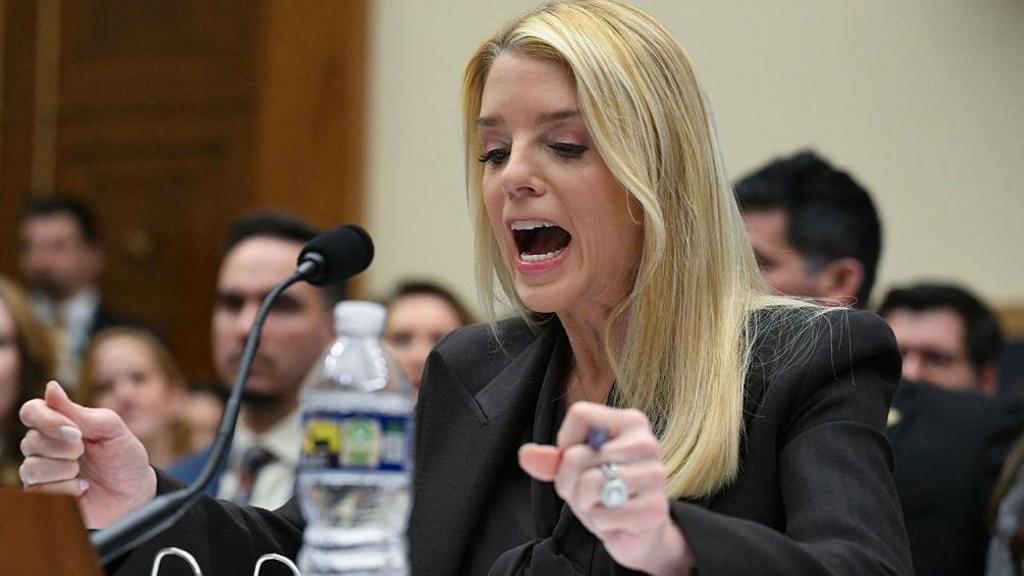
Attorney General Pam Bondi declined to give the simple yes-or-no answer lawmakers wanted.
She said she would not play a yes-or-no game and argued that the Department of Justice would examine any credible lead involving victims.
But that answer did not ease tensions.
It made them worse, because in a hearing where members had only minutes to question the attorney general, anything short of a direct response felt to critics like strategic delay.
The frustration in the room became visible almost immediately.
Lawmakers pressed the point that they were not asking for proof beyond doubt, but for a basic legal judgment about whether certain records were enough to justify further scrutiny.
That distinction mattered.

In high-profile investigations, credible evidence and final proof are not the same thing, and members of Congress were clearly trying to expose what they saw as a widening gap between those two standards.
The hearing then widened into a much bigger fight about transparency itself.
Bondi emphasized that the Department of Justice had released millions of pages of records related to the Epstein case, presenting that release as evidence that the government was acting openly.
But critics in the room were not impressed by the number alone.
They argued that transparency is not measured by the sheer volume of paper released, but by whether the most important names, details, and leads remain visible rather than buried under redactions.
That is where the hearing became politically radioactive.
Because once lawmakers started arguing that the release of documents may have created the appearance of openness while still concealing critical information, the entire presentation of transparency came under suspicion.
One lawmaker said it was practically impossible for Congress to meaningfully review the full body of records under the conditions the Department of Justice had created.
According to the hearing, hundreds of members had access rights, but only a tiny number of computers were available for reviewing millions of pages.
That detail hit hard because it made the process sound less like open oversight and more like symbolic access.

In other words, critics suggested the files were technically available while still functionally beyond the reach of timely congressional review.
That accusation is powerful in any hearing.
But in a case tied to Jeffrey Epstein, where the public already suspects that partial truth and selective visibility have defined the story for years, it becomes explosive.
Another major line of criticism centered on redactions involving Donald Trump’s name and other high-profile individuals.
Lawmakers argued that extensive redactions may have removed politically sensitive references, turning the file release into a controlled disclosure rather than a fully honest one.
Supporters of the Department of Justice countered that redactions are common, necessary, and sometimes legally required.
But critics insisted that redactions can also become shields, especially when applied to names and details the public believes are most relevant to understanding the wider network around Epstein.
That is the deeper fear haunting this case.
Not merely that information is being reviewed carefully, but that careful review has become a permanent excuse for selective visibility and incomplete accountability.
Then the hearing moved into even more volatile territory.
Lawmakers raised concern over a witness tip from years ago, reportedly involving a limo driver who claimed to have overheard a disturbing conversation connected to Epstein’s world.
The point was not that the tip proved guilt.
The point was that critics said the witness was never fully interviewed, turning the issue into another example of possible leads that may not have been pursued as aggressively as the public would expect.
That allegation carries enormous emotional force.
Because many Americans believe the Epstein scandal is not just about what happened, but about how often institutions looked away, slowed down, or failed to push hard enough when influential people were nearby.
The hearing also produced one of the most startling optics of the entire day.
A photograph reportedly showed what appeared to be a lawmaker’s document search history printed inside Bondi’s binder of notes.
That image triggered immediate concern about oversight and surveillance.
If the Department of Justice was tracking what members of Congress were searching while reviewing sensitive Epstein-related materials, critics argued that it could chill oversight itself.
Now, to be fair, secure government systems often log access to files.
But the visual impact of seeing a lawmaker’s search history printed in the attorney general’s binder made the situation look far more personal, strategic, and adversarial than routine data security.
That kind of image changes everything.
Congressional hearings often hinge less on dense legal detail than on one moment or one piece of paper that seems to reveal the real power dynamics underneath the room.
The hearing also brought survivors back to the center of the story, where many lawmakers argued they should have been all along.
Several survivors had come to Washington and were seated behind the witness table, listening as politicians argued over records, redactions, and accountability.
That was perhaps the most haunting part of the entire spectacle.
While officials debated legal definitions and document handling, the people most directly harmed were still waiting for signs that the institutions of justice truly saw them, heard them, and prioritized them.
According to statements during the hearing, many of the survivors present said they had not been contacted by the Department of Justice during the latest review process.
That claim, whether seen as a bureaucratic failure or something worse, intensified the sense that the human core of this case had once again been pushed to the margins.
This is why the Epstein scandal refuses to fade.
It is not just a criminal case anymore, but a cultural and institutional wound involving abuse, wealth, influence, and the unsettling suspicion that some people always receive softer treatment than others.
Critics argue that the hearing showed a justice system still struggling to prove it is willing to follow every lead wherever it goes.
Supporters of the Department of Justice argue that complex investigations require time, legal care, and protection for victims, not political grandstanding built for viral outrage.
Both sides now have material to use.
One side will point to millions of released pages and say the government has done more than enough to show openness.
The other side will point to evasive answers, selective redactions, limited file access, overlooked witness tips, and survivor frustration and say the appearance of transparency is not transparency at all.
That is exactly why this moment is likely to keep spreading online and across political media.
The hearing touched almost every nerve in modern American distrust.
Questions about elite protection, institutional credibility, government opacity, and whether justice still works the same way when powerful names are involved all came crashing together in one room.
And when that happens, people do not walk away calmly.
They pick sides, they share clips, they argue harder, and they return to the case with even more suspicion than before.
For Bondi, the political damage is not just that she was attacked in Congress.
It is that the hearing made her look like the face of an institution struggling to answer the clearest questions with the clearest words.
For her critics, that alone is enough to deepen outrage.
Because when the attorney general cannot or will not give simple direct answers in a case this morally charged, the public is left to fill the silence with its own worst assumptions.
That is never a good place for a justice system to be.
Especially in a case that already feels to millions of people like the ultimate test of whether the powerful are ever really exposed to the same scrutiny as everyone else.
The hearing ended, but nothing felt resolved.
If anything, the confrontation widened the gap between what officials say has been done and what the public believes still remains hidden.
That may be the most important takeaway of all.
The fight over the Epstein files is no longer just about what happened years ago, but about whether America’s institutions can still persuade people that they are telling the whole truth now.
Right now, many people are not convinced.
And after this hearing, that distrust may only grow louder.
Because when survivors are still waiting, lawmakers are still pressing, redactions are still disputed, and direct answers are still avoided, the public reaches a simple conclusion.
The story is not over, and the system still has not earned the benefit of the doubt.
