The Redacted Witness: Ted Lieu and the Search for Epstein’s “Third Parties”
The aesthetic of a congressional hearing is typically one of rehearsed sobriety, but this week, the House Judiciary Committee became the site of a visceral legal ambush. In a confrontation that has since gone viral, Representative Ted Lieu (D-CA) utilized a single redacted photograph to challenge the foundational testimony of Attorney General Pam Bondi, reigniting a national debate over whether the Department of Justice is protecting the survivors of Jeffrey Epstein or the powerful men who populated his orbit.
The Logic of the Blur
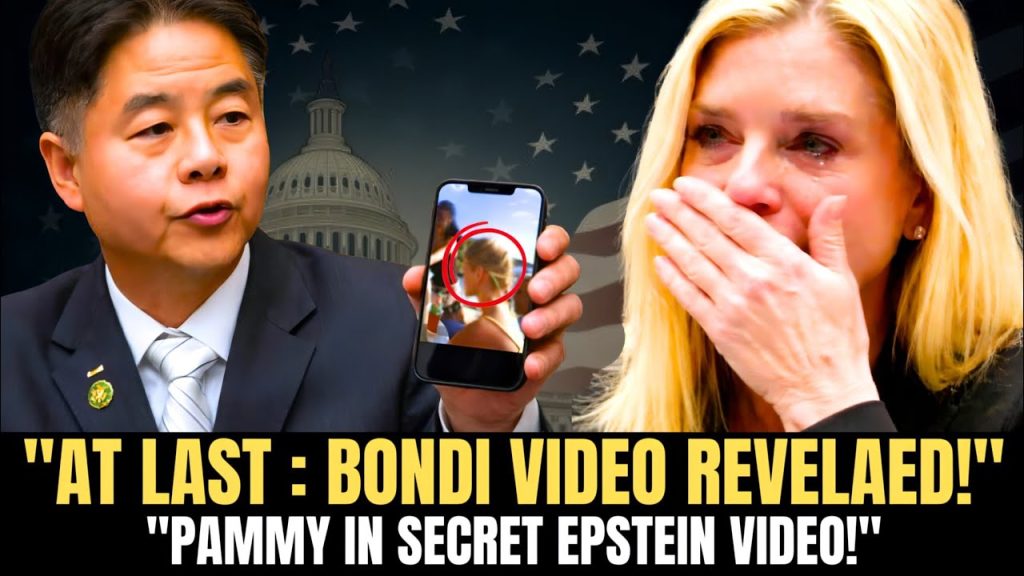
Lieu’s interrogation began not with a speech, but with a visual aid: a photograph of Prince Andrew alongside a young woman. The image, sourced from the DOJ’s own “Epstein Files,” featured a critical modification—the woman’s face was blurred out.
“Under the law Congress passed, you were allowed to redact photos to protect the victims,” Lieu noted with the cold precision of a former prosecutor. He then moved Bondi to confirm that the redaction was a deliberate act of compliance with federal victim-protection statutes.
By obtaining that confirmation, Lieu closed a logical trap. If the DOJ recognizes the individual in the photo as a victim under the Federal Victims Trafficking Protection Act, Lieu argued, then the man she is pictured with—an uncharged third party—is, by definition, a participant in a criminal orbit. “These two photos staring you in the face are evidence of a crime,” Lieu declared, “and more than enough to predicate an investigation.”
The July 2025 Memo
The “explosion” in the hearing room centered on a specific Department of Justice memo from July 2025. That document served as the official “door-closer” on the Epstein investigation, stating that federal authorities had uncovered no evidence that could justify pursuing uncharged third parties.

Lieu pointed to the authenticated photographs as a direct refutation of that memo. He questioned how the department could simultaneously recognize a victim in its redaction process while claiming a total lack of evidence to investigate the associates pictured with her. When Bondi attempted to deflect by citing the failures of previous administrations—including those of Merrick Garland and Bill Barr—Lieu’s response was immediate: “I agree with you… a whole string of failures, but you are in charge. You have the power to change things, and you’re doing the opposite.”
The Anonymous Witness and the Limo
The stakes escalated further when Lieu introduced a document from the FBI’s National Threat Operations Center. The report detailed the testimony of a witness who allegedly drove Donald Trump in a limousine and overheard a violent telephonic exchange with Jeffrey Epstein. The witness further claimed to have met a young woman who alleged she was assaulted by both men—a woman who was later found dead in a suspected suicide that local officers reportedly found suspicious.
When Bondi dismissed the allegations as “ridiculous” and a “deflection,” Lieu accused the Attorney General of lying under oath. “No one at the Department of Justice interviewed this witness,” Lieu claimed, demanding an immediate investigation. The Attorney General’s reaction was a sharp, personal pivot, snapping back, “Don’t you ever accuse me of a crime,” before redirecting the conversation toward California’s “sanctuary city” policies and crime statistics in Lieu’s home state.
The Exposure of the “Jane Does”

Beyond the high-profile sparring, the hearing touched on a deeper institutional failure: the exposure of the victims themselves. For years, many of Epstein’s accusers were protected by “Jane Doe” status. However, the recent release of millions of documents saw a breakdown in these protections.
Reports indicate that real names were inadvertently made public, a move that survivors have described as a “betrayal” of their trust in the system. Attorney Gloria Allred, representing several victims, has categorized the handling of these files as “careless at best” and “a cover-up at worst,” noting that while survivors’ names were exposed, the identities of many “predators” remained carefully hidden behind heavy redactions.
A Broken Trust
As the hearing adjourned, the “Accountability Gap” remained the central theme of the day. On one side, the Department of Justice maintains its position: the case is closed, the evidence is insufficient, and the most recent document dump is the final word. On the other side is a growing collection of photographs, witness statements, and congressional testimonies that suggest the story is far from over.
Lieu’s “decency” comment—calling for Bondi’s resignation—signaled that for many in Washington, the Epstein investigation is no longer about the financier himself, but about the integrity of the institutions tasked with investigating his network. With 1,000 victims still waiting for an accounting of the “third parties” involved, the confrontation in the Judiciary Committee suggests that while the files may be closed, the questions are only getting louder.
