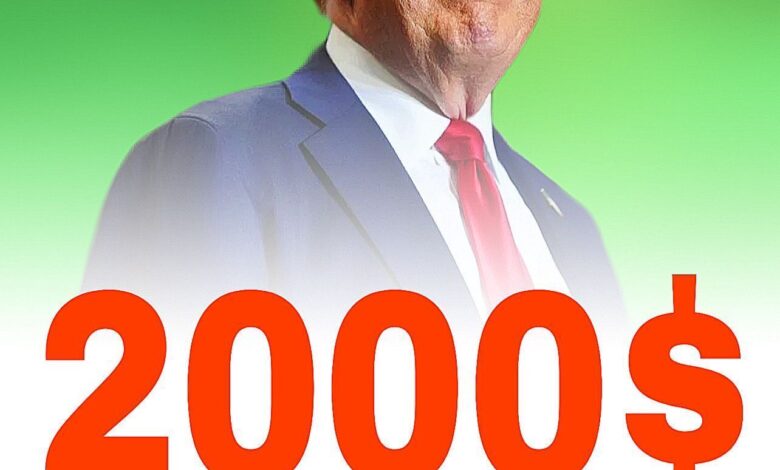
Donald Trump’s latest declaration—an assertive suggestion that Americans could expect $2,000 direct payments on a specific date—landed like a spark in a room full of dry tinder. It was bold, dramatic, and crafted to hit the emotional center of a country still battered by inflation, stagnant wages, and the constant pressure of rising living costs. The promise wasn’t wrapped in policy jargon or buried under legislative language. It was simple: a date, a dollar amount, and the implication of immediate relief. And that simplicity is exactly what made it explode across the national conversation within minutes.
For millions of households, the idea of a check landing before Christmas hit a nerve. December is a financial chokehold in the best of times—gifts, travel, heating bills, medical deductibles resetting, school breaks requiring childcare, and groceries that cost more every month. Families have been stretching paychecks until they nearly snap, and the mere possibility of $2,000 suddenly appearing in their bank accounts felt like someone finally acknowledging how hard things have become. It wasn’t just a number. It was a lifeline tied to a specific moment, a promise of breathing room backed by the weight of a former president’s voice.
A date is powerful. It creates urgency. It creates hope. It creates the illusion that political chaos can be bypassed with a stroke of willpower. And Trump knows better than anyone how to package a message that sticks.
But behind that clean, emotional headline sits a dense knot of economic and political complications—ones that economists, policy analysts, and trade experts immediately jumped on. What sounded like a direct, uncomplicated transaction—tariffs funding household payments—was anything but.
Trump framed tariffs as the core funding mechanism, implying that money collected from foreign nations could be funneled directly into American pockets. In reality, tariffs function much more like a tax on imports—costs paid by U.S. companies that often get passed down to U.S. consumers. The idea of redirecting tariff revenue toward large-scale direct payments raised questions within minutes. How much revenue would these tariffs actually generate? Would they reliably sustain recurring payments? Would increased tariffs result in higher consumer prices, effectively giving Americans money with one hand while taking it back with the other through more expensive goods? None of that was addressed in Trump’s announcement.
Economists warned that even if tariff revenue were to spike dramatically, the structure required to channel that money into checks would demand congressional approval, legal rewrites, and complex administrative systems. A president can’t simply declare a payout date and wire money overnight—no matter how appealing the headline might be.
Policy specialists pointed out that previous direct payments—like the pandemic stimulus checks—were funded through congressional bills, not unilateral executive decisions. The machinery behind those payments involved legislation, negotiation, and extensive coordination among federal agencies. Even the fastest iterations took weeks or months to push through. Trump’s confident tone bypassed all of that nuance, leaving supporters energized and critics scrambling to explain why the proposal wasn’t as straightforward as it sounded.
Supporters of the idea weren’t focused on mechanisms or legal hurdles. They honed in on the emotional promise: $2,000, before Christmas, from a man who had previously championed direct aid during the pandemic and understood the political potency of cash relief. Trump’s message reminded his base—and even some weary independents—of the earlier stimulus payments that had briefly made life feel manageable. Many Americans still associate him with those checks, regardless of the political battles that surrounded them.
Opponents countered that the announcement was a strategic move designed to tap into economic anxiety at a moment when household budgets are under maximum pressure. Critics argued the promise was political theater, timed for impact rather than feasibility. But even they had to acknowledge the effectiveness of the messaging. Direct payments cut through cynicism in a way that few policies can. They’re immediate. They’re personal. They require no interpretation. And they give voters something tangible to tie their hopes to.
The emotional resonance of Trump’s claim revealed just how strained Americans have become. Inflation may have cooled on paper, but wages haven’t caught up, housing costs remain suffocating, food prices continue to climb, and medical expenses drain families faster than they can recover. Many households live one unexpected bill away from crisis. A message offering relief with a date attached wasn’t just political—it was psychological.
There’s also a cultural layer beneath the economics. Direct payments symbolize something rare: a moment when government—any government—actually feels like it’s responding to real-world needs with no complicated strings attached. Even the hint of that is enough to energize exhausted citizens.
In the days that followed the announcement, political commentators debated motives, logistics, and economic impacts, while households debated something simpler: “What would we do with the money?” The conversation spread because the need is real. The stress is real. And the yearning for relief is universal.
But the practicality remains tangled. Tariff-based funding for mass direct aid is, according to analysts, unstable and potentially inflationary. Congressional approval would be required. Structural mechanisms would need to be built. And the claim of an “exact date” sidesteps the layers of bureaucracy that determine how federal money actually moves.
Still, Trump’s announcement did something undeniably powerful: it shifted the national conversation in one sentence. It forced policymakers, economists, and media outlets to react. It reminded voters of the emotional punch of financial promises. And it injected hope—cautious or naïve, depending on who you ask—into households that haven’t felt hopeful for a long time.
Whether the idea ever becomes reality is uncertain. The pathway is steep, tangled, and politically explosive. But the message struck a chord because it wasn’t just about money. It was about timing, desperation, and the simple human desire for relief during a season when the pressure feels heaviest.
Trump didn’t just propose a payment. He touched a wound sitting right under the surface of American life. And that’s why the country reacted the way it did—fast, emotional, and divided, but undeniably engaged.
